Why 'Off-the-Shelf' Sorting Doesn't Work: The Need for Customized Solutions
The “Plug-and-Play” Myth in Manufacturing
When manufacturers first decide to automate their quality control, the initial instinct is often to look for a quick fix—an “off-the-shelf” sorting machine that can simply be plugged in and turned on.
It sounds ideal in theory. However, in the complex world of high-volume manufacturing, the plug-and-play promise rarely survives contact with reality.
Why? Because your products are unique. An automotive valve behaves differently on a conveyor belt than a medical plastic syringe. A highly reflective metal washer reflects light differently than a matte rubber O-ring. When factories try to force complex, uniquely shaped parts through standard, generic sorting machines, they encounter three major headaches: constant jamming, high false-reject rates, and missed defects.
To achieve true zero-defect manufacturing, the equipment must adapt to the product, not the other way around. Here is why tailoring the machine to your specific part geometries through custom vision inspection is the only way to guarantee 100% reliable quality control.
1. The Geometry Problem: Feeding and Handling
Before a camera can ever inspect a part, the machine must successfully feed, orient, and present that part to the lens. This is where off-the-shelf machines fail most frequently.
Every manufactured part has a unique center of gravity, friction coefficient, and interlocking tendency.
- Interlocking Parts: Products like springs or C-clips tend to tangle together when poured into a bulk feeder. A generic vibration bowl will simply create a giant, jammed knot of metal.
- Unstable Centers of Gravity: Heavy-headed bolts or asymmetrical automotive stampings won’t sit flat on a standard conveyor belt. If the part is wobbling as it passes the camera, the dimensional measurement will be wildly inaccurate.
The Customized Solution:
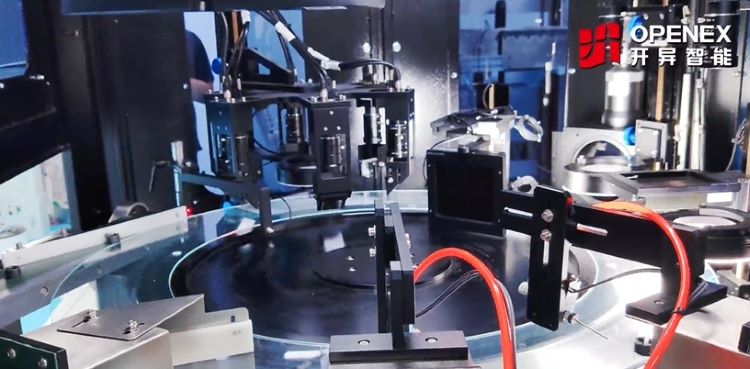
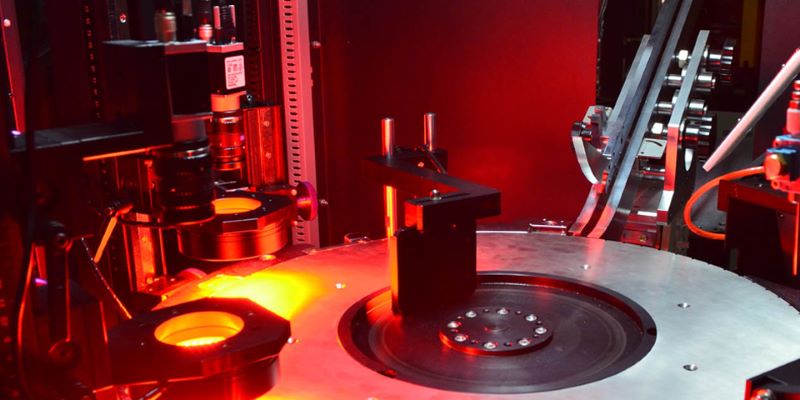
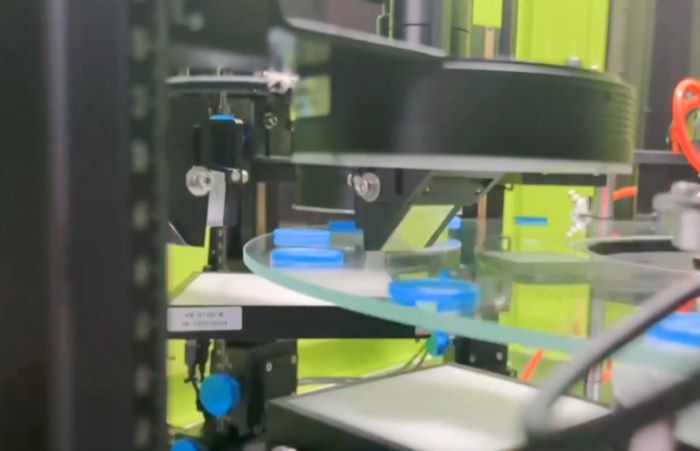
At Openex Automation, we don’t use generic feeding mechanisms. We engineer custom vibration bowls, centrifugal feeders, and specialized track tooling based strictly on the CAD data and physical geometry of your parts. Whether it requires a glass plate for flat hardware or an index dial table for unstable cylindrical parts, the mechanical handling is built precisely for your product.
2. The Optics Challenge: Lighting the “Unseen”
Machine vision is entirely dependent on light. If a defect isn’t properly illuminated, the camera cannot see it, and the software cannot reject it.
Standard optical sorting machines usually feature a basic ring light. While this might work for simple flat washers, it is entirely inadequate for complex part geometries.
- Hidden Features: How do you inspect the internal threads of a deep nut?
- Reflective Surfaces: How do you spot a 0.05mm scratch on a highly polished, mirror-like bearing without the light blinding the camera?
- Shadows: Tall, complex parts will cast shadows over their own base, hiding potential cracks or burrs.
The Customized Solution:
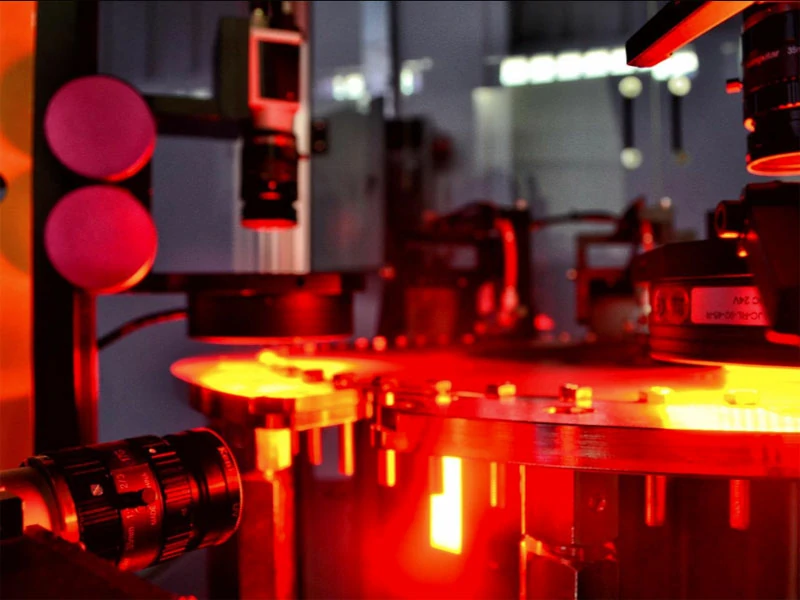
Tailoring the machine means customizing the optical layout. Depending on your part’s geometry, our engineers might combine low-angle lighting to cast shadows over surface scratches, dome lighting to eliminate glare on reflective parts, and specialized coaxial lights to illuminate deep blind holes. The camera positions (top, bottom, and 360-degree side views) are physically mapped to target your most critical inspection zones.
3. Software & AI: Training for Your Specific Standards
A scratch on a decorative mobile phone casing is a critical failure. The exact same scratch on an internal automotive engine bracket might be completely acceptable.
Off-the-shelf algorithms operate on rigid, generic rules. They don’t understand the nuance of your specific industry standards. This leads to False Rejects (the machine throws away perfectly good, sellable parts) or Escapes (the machine passes a defective part).
The Customized Solution:
A truly customized sorting machine utilizes Deep Learning and AI trained specifically on your production data. By feeding the AI thousands of images of your specific “Good” parts and “Bad” parts, the software learns to distinguish between a harmless water stain and a critical structural crack, just like your best human inspector would—only thousands of times faster.
The Openex Approach: Engineered for Your Reality
At Openex, we know that an optical sorting machine is a major investment, and it has to work flawlessly from day one. That is why we don’t sell machines from a catalog; we engineer solutions.
Our customization process includes:
- Sample Testing: You send us physical samples of your good and defective parts.
- Feasibility Study: Our engineers design a custom lighting, feeding, and optical layout specifically for your part’s geometry.
- Proof of Concept: We run your parts through our lab systems to prove that we can hit your required speed (e.g., up to 1,200 parts/min) and accuracy tolerances.
- Custom Build: We manufacture the machine tailored entirely to your production line.
Whether you need a dedicated Fasteners Inspection machine or a complex inline gauging system for precision-machined auto parts, bespoke engineering is the key to unlocking true ROI.
Stop Compromising on Quality Control
Trying to force your unique products through a generic machine will cost you more in downtime, maintenance, and false rejects than the initial savings of buying “off-the-shelf.” Invest in a system designed for your exact geometry, your exact defects, and your exact speed.
Ready to see what a customized solution looks like for your parts?
Contact Openex Automation today to request a free sample inspection and a customized machine proposal. Let our engineers build the perfect gatekeeper for your quality control.